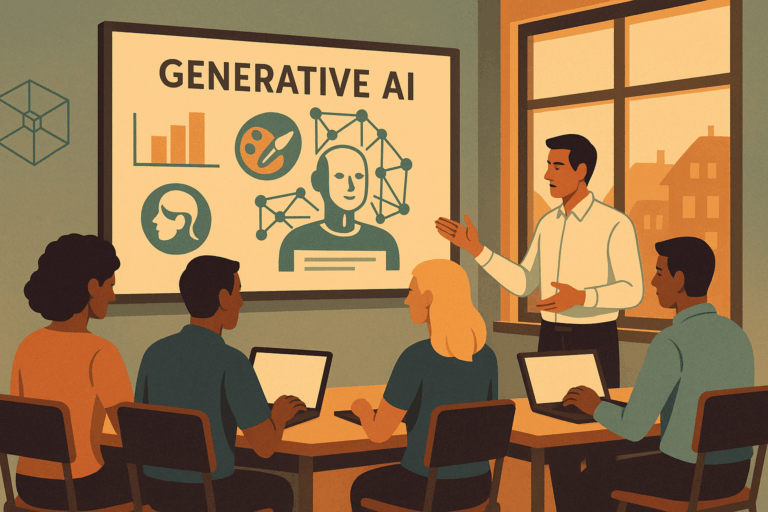

GenAI Literacy: The new baseline skill every business must build
Companies across Europe are racing to deploy generative AI. Yet most are confusing access with readiness – and paying the price.
Redesigning Work for the AI Era
According to Deloitte’s State of AI in the Enterprise 2026, 84% of companies have not redesigned jobs or work processes around AI capabilities, despite recognising that insufficient worker skills are the single biggest barrier to integration. Meanwhile, McKinsey’s Superagency in the Workplace (2025) found that while 92% of companies plan to increase AI investment, only 1% consider themselves mature in AI deployment. The reality is that while the tools are everywhere, the internal capability is still catching up.
The root cause is a fundamental misunderstanding of what AI training actually requires. Most organisations focus on tool access and basic awareness – what McKinsey calls “AI literacy” – while neglecting the harder work of embedding AI into actual workflows and decision-making. As McKinsey’s Redefine AI Upskilling as a Change Imperative (2025) illustrates, one company ran an AI literacy course for all employees, yet a month later, adoption was minimal because workflows, incentives, and management behaviours remained unchanged.
The Real Driver of Performance
It is rarely a motivation problem. Research published by ATD (2026) shows that individual motivation accounts for just 7% of performance outcomes, while organisational learning systems account for over 23% – more than three times the impact. Essentially, employees aren’t failing AI training; rather, the systems around them are.
The answer lies in treating GenAI literacy as a structured, designed competency rather than a one-off workshop or self-directed experiment. As the HBR report (2026) argues, organisations that embed learning into real workflows, redesign roles around AI outputs, and create feedback loops for experimentation are the ones building durable capability. The EY Work Reimagined Survey 2025 confirms this: the biggest driver of AI adoption value is skillset, accounting for 49% of an employee’s AI adoption score.
GenAI literacy is now the new baseline, and the challenge today for organisations is ensuring that the training offered is actually designed to deliver results.
_____________
Sources
- Association for Talent Development (ATD) (2026). Why Your Skills Training Will Fail Unless You Fix These 5 Things First. [online] Available at: https://www.td.org/content/atd-blog/why-your-skills-training-will-fail-unless-you-fix-these-5-things-first [Accessed 4 Mar. 2026].
- Deloitte (2026). The State of AI in the Enterprise. [online] Available at: https://www.deloitte.com/us/en/what-we-do/capabilities/applied-artificial-intelligence/content/state-of-ai-in-the-enterprise.html [Accessed 4 Mar. 2026].
- EY (2025). EY 2025 Work Reimagined Survey: Executive Summary. [online] Available at: https://www.ey.com/content/dam/ey-unified-site/ey-com/en-in/newsroom/2025/12/ey-2025-work-reimagined-survey-executive-summary.pdf [Accessed 4 Mar. 2026].
- Harvard Business Review (2026). Close Your Workforce’s AI Skills Gap by Designing an Adaptive Organization. [online] Available at: https://hbr.org/sponsored/2026/02/close-your-workforces-ai-skills-gap-by-designing-an-adaptive-organization [Accessed 4 Mar. 2026].
- McKinsey & Company (2025). Redefine AI upskilling as a change imperative. [online] Available at: https://www.mckinsey.com/capabilities/people-and-organizational-performance/our-insights/the-organization-blog/redefine-ai-upskilling-as-a-change-imperative [Accessed 4 Mar. 2026].
- McKinsey & Company (2025). Superagency in the workplace: Empowering people to unlock AI’s full potential at work. [online] Available at:https://www.mckinsey.com/capabilities/tech-and-ai/our-insights/superagency-in-the-workplace-empowering-people-to-unlock-ais-full-potential-at-work [Accessed 4 Mar. 2026].