A Beginner’s Guide to Generative AI in Music
For decades, technology has helped us record and edit music. But for the first time in history, technology is creating it. Generative AI is shifting music from something we simply play to something we co-author with algorithms.
How does a computer “write” a song?
Generative AI doesn’t “feel” music; it calculates it. Modern models (like Suno, Udio, or Meta’s AudioCraft) work through two primary methods:
- Large Language Models (LLMs) for Notation: The AI learns the “grammar” of music, which notes and chords typically follow each other in a jazz song versus a techno track.
- Diffusion Models for Sound: Similar to how AI creates images from visual noise, audio AI starts with “static” and shapes it into clear sound waves, mimicking the texture of a real guitar or a human voice.
Beyond the “Play” Button: Key Capabilities
The impact of Gen AI goes far beyond just making a song from a text prompt.
- Style Transfer: Imagine taking a melody you hummed and instantly turning it into a 1920s swing recording.
- Stem Separation: AI can now “unbake the cake,” perfectly separating vocals from drums in an old recording, allowing for high-quality remixes of classic tracks.
- Endless Soundscapes: Video games now use AI to generate “infinite” background music that changes in real-time based on the player’s actions.
The “Human-in-the-Loop” Model
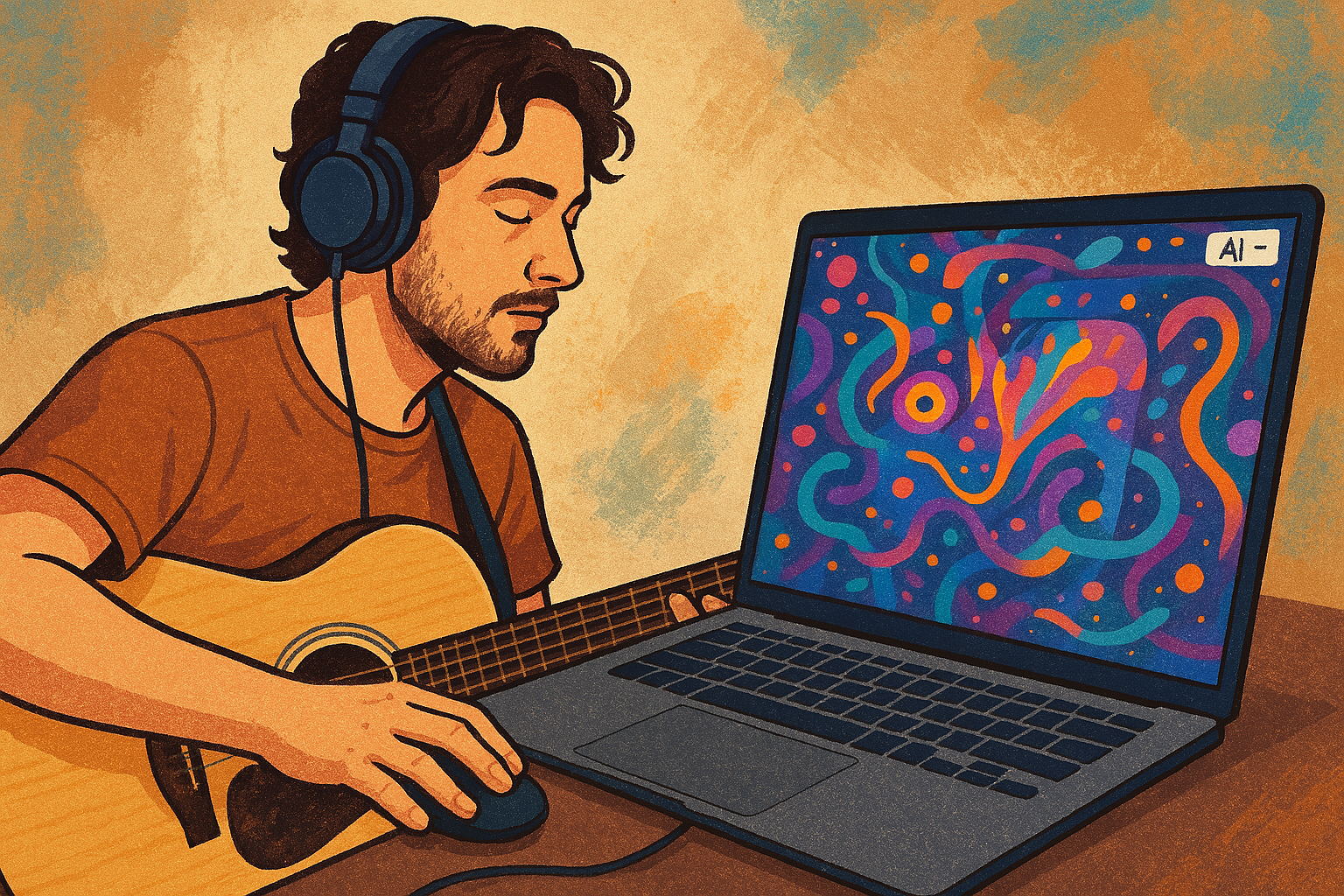
The most successful use of AI in music isn’t replacing the artist, but acting as a creative co-pilot.
- Curing “Blank Page” Syndrome: A producer might ask an AI for ten different bassline variations to find a spark of inspiration.
- Democratisation: People with physical disabilities or those who never had the chance to learn an instrument can now translate the melodies in their heads into professional-sounding audio.
The Big Debate: Ethics and Ownership
The rise of AI music has triggered a legal earthquake. Two main questions dominate the conversation in 2026:
- Training Data: Is it fair for an AI to learn from a songwriter’s catalogue without paying them?
- Identity: If an AI can perfectly mimic the voice of a famous pop star (a “Deepfake Vocal”), who owns the rights to that performance?
Conclusion
Generative AI is the “new synthesiser.” When the synth first appeared, people feared it would kill live music; instead, it gave birth to entirely new genres like Disco and Synthwave. Similarly, Gen AI is not the end of the musician – it is the beginning of a new era of hybrid creativity.