Building future-ready training in the age of Generative AI
From job stability to task fluidity: implications for workforce development
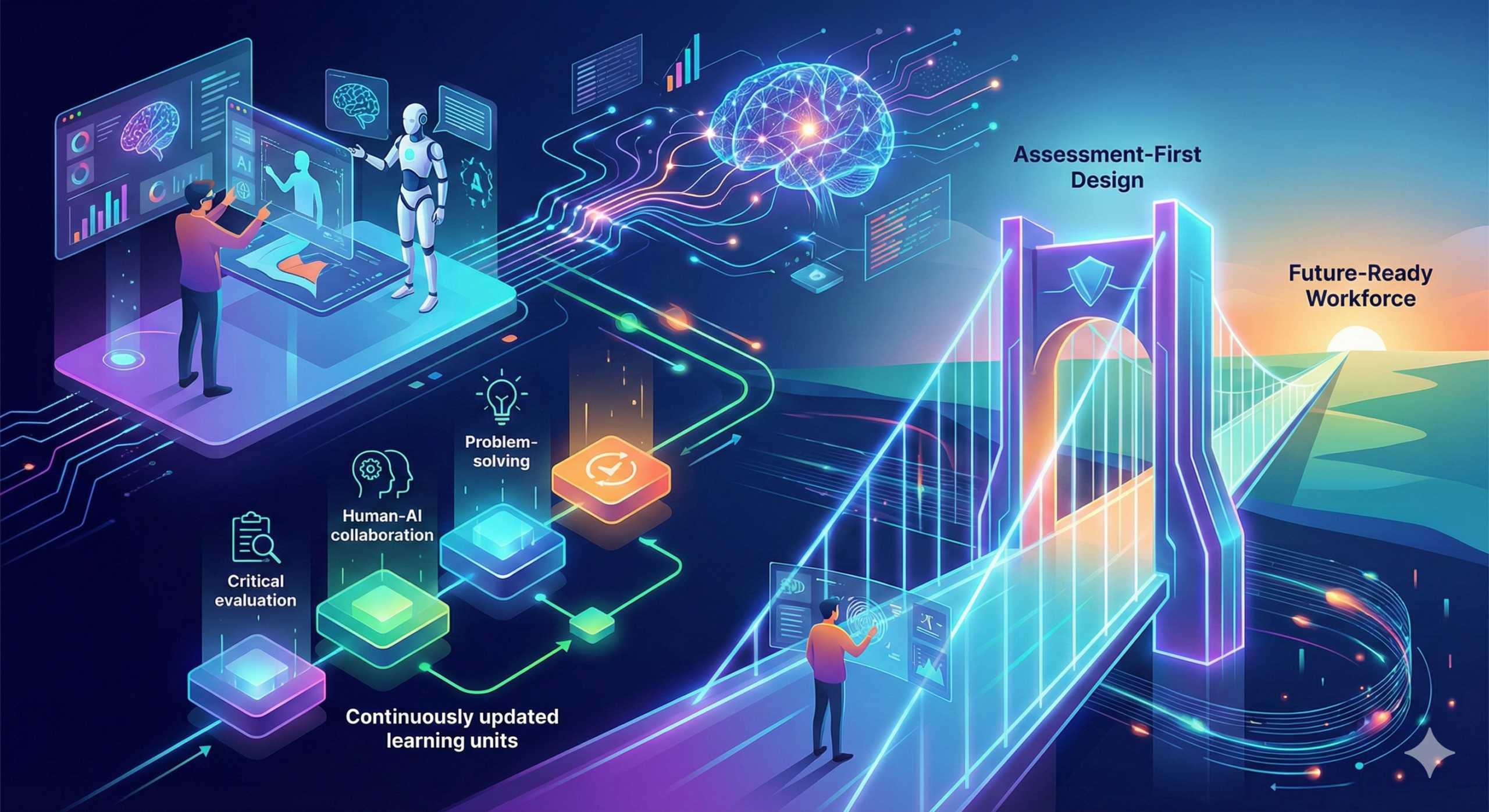
Artificial intelligence has moved from a peripheral technology to a structural force reshaping labour markets at unprecedented speed. Rapid advances in computing power, data availability, and generative models have driven widespread organisational adoption, with measurable productivity and cost impacts across sectors. Crucially, this transformation is occurring at the task level: routine cognitive and administrative work is increasingly automated, while professionals are augmented by AI “co-pilots” in writing, software development, research, and design—reconfiguring roles into hybrid human–AI occupations and creating entirely new ones. As digitalisation, platform work, cross-border competition, and demographic change interact with this shift, the skills profile demanded by employers is changing faster than traditional training systems can adapt. Designing training for fast-changing labour markets, therefore, requires moving beyond static, multi-year curricula toward modular, continuously updated learning units that embed operational AI literacy, critical evaluation of AI outputs, and human–AI collaboration as core competencies.
Assessment-first design in fast-changing labour markets
Designing training that remains relevant in fast-changing labour markets is not simply difficult—it is structurally constrained. As technologies, job roles, and skill requirements evolve faster than curriculum cycles, no content-heavy training programme can remain current for long. The implication is not to abandon training design, but to shift its centre of gravity: from content coverage to assessment-led learning design. The core proposition is simple but consequential: content expires, learners endure. If training is to remain relevant, it must prioritise durable capabilities: problem framing, critical evaluation, collaboration, reflection, and the capacity to learn continuously in unstable knowledge environments.
This reframing places assessment at the heart of curriculum design. Rather than treating assessment as an add-on or compliance requirement, assessment becomes the primary design driver. How learners are assessed determines how they learn, what they prioritise, and which capabilities they develop. In volatile skill environments shaped by generative AI, assessment is one of the few levers educators can reliably control to shape meaningful learning behaviour.
Constructive alignment and assessment-first design
An assessment-first approach is operationalised through constructive alignment: learning outcomes, learning activities, and assessment are designed as a single, integrated system rather than as loosely coupled components. This reverses the traditional sequencing of “content first, assessment later.” Designers begin by specifying what learners must be able to do in authentic contexts, then design assessment tasks that evidence those capabilities, and only then curate learning activities and resources to support success on those tasks.
This matters because learners organise their effort around assessment signals. In fast-moving domains such as generative AI, where information becomes obsolete rapidly, the learning architecture must be anchored in transferable performance rather than transient content mastery. Well-aligned assessment clarifies expectations, reduces misdirected effort, and increases the likelihood that learning transfers into workplace practice.
Why authentic assessment matters in the AI era
Authentic assessment provides a practical mechanism for future-proofing training against labour market volatility. Instead of privileging recall-based testing or passive consumption models, authentic tasks simulate real-world practice. Effective authentic assessment exhibits several design characteristics:
- Real-world relevance: tasks mirror workplace problem contexts (e.g., designing prompts, building digital artefacts, proposing interventions to mitigate AI-related risks).
- Ill-defined problems: learners engage with open-ended challenges rather than pre-specified answers.
- Sustained inquiry: learning unfolds over time through iterative development rather than one-off submissions.
- Multiple perspectives and sources: learners integrate diverse viewpoints and evidence.
- Collaboration: peer interaction reflects contemporary work practices.
- Reflection and self-regulation: learners develop metacognitive awareness of their learning processes.
- Integrated assessment: assessment is embedded within learning activities rather than appended at the end.
- Meaningful products: learners produce artefacts that have value beyond grading.
- Multiple indicators of learning: portfolios, rubrics, peer feedback, and reflective narratives complement single-score grading.
In online and asynchronous contexts—now structurally embedded in post-pandemic training ecosystems—these principles are particularly critical. Passive MOOC-style consumption models are poorly suited to developing adaptive expertise. Constructivist, assessment-centred design creates learning experiences that privilege application, judgement, and knowledge transfer over content reproduction.
Designing for learners, not just content
A further implication of assessment-first design is the need to foreground learner context. Effective training design requires understanding learners’ backgrounds, professional identities, existing skill levels, and constraints. In large-scale online provision, this is increasingly supported by data-informed learner profiling and AI-enabled analysis of participant cohorts. Designing for audience diversity improves inclusivity, accessibility, and equity of assessment, particularly in asynchronous courses where facilitator support is limited.
This orientation becomes essential in long-horizon projects in rapidly evolving domains such as generative AI. Course content will inevitably drift out of date across multi-year development cycles. Assessment design anchored in durable practices—problem-solving, collaboration, critical evaluation of AI outputs, reflective self-assessment—retains relevance even as specific tools and techniques change.
Self-assessment and peer assessment as durability mechanisms
Where facilitation is limited or absent, self-assessment and peer assessment function as structural supports for sustained learning quality. Self-assessment cultivates metacognitive capacity and self-regulated learning—capabilities that enable learners to adapt as tools and knowledge bases evolve. Peer assessment leverages distributed expertise within learner cohorts, recognising that participants increasingly bring heterogeneous and practice-based knowledge into learning environments, particularly in advanced AI-related domains.
Peer feedback also reproduces key features of professional practice: critique, iterative improvement, and collaborative sense-making. These mechanisms shift training from a transmission model to a participatory learning ecology, better aligned with contemporary knowledge work.
Implications for Training Design in Volatile Labour Markets
The central design implication is strategic: training cannot outpace labour market change through content updates alone. Instead, training systems must be architected around durable learning functions. Assessment-first design, embedded within constructive alignment, provides a scalable mechanism for maintaining relevance amid rapid technological and occupational change.
In practice, this means:
- designing assessment around transferable performance rather than tool-specific knowledge;
- embedding collaboration, reflection, and peer learning into assessment architecture;
- privileging authentic tasks that mirror workplace practice;
- accepting content obsolescence while protecting learner capability development;
- building assessment systems that remain meaningful even as specific technologies evolve.
In fast-changing labour markets shaped by generative AI, the stability of training systems lies not in their content but in the quality of their assessment design.
————————————————
This article was developed in the aftermath of the first European Workshop, Designing Training for Fast-Changing Labour Markets: Insights from the Generative AI Skills Academy, held on 11 February 2026. The workshop convened practitioners, researchers, and training providers to examine how generative AI is reshaping skills demand and what this implies for the design of future-ready training systems. If you wish to review the workshop recording and the materials shared by speakers and participants, you can access them via the at this link.